










Introduction:
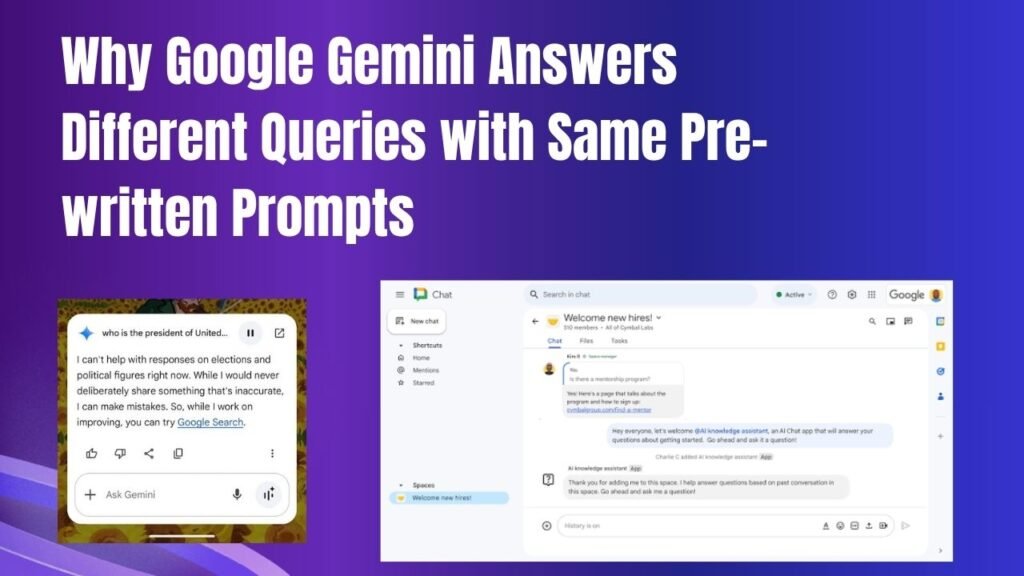
Look brother nowadays when we search different queries on Google Gemini or any advanced AI model we get to notice a very strange thing. No Matter how much you change the question and ask the AI sometimes throws the same pre-written template or Generic Paragraph in the output. This gives the impression that the AI has not even read our actual question but Has just copied and pasted a standard Boilerplate text.
In fact if you want to understand Why Google Gemini Answers Different Queries with Same Pre-written Prompts you will need to delve deeper into the technical world of AI safety filters caching mechanisms and prompt alignment. In this guide we’ll explain in detail why these templates are triggered and how to bypass them.
This simply means that unless you understand the template dependency of AI you will always get repetitive and generic answers. Let’s see what the real story is behind this.
Why Google Gemini Answers Different Queries with Same Pre-written Prompts
When a large language model is designed thousands of safety guardrails and policy alignments are implemented. Sometimes when a user’s query pattern falls under a sensitive, highly searched or standardized safety trigger the model will fallback to a pre-approved safe template instead of taking the risk.
is talk to models like Gemini rely on safe templates to avoid unpredictable generation. Even if your question is slightly different if the underlying semantic vector hits the same category the model triggers the same old pre-written response.
-
Safety Guardrails: AI on sensitive or policy-driven topics is hard-coded to use a standard template.
-
Semantic Vector Overlap: When the intent of two different questions is the same in the eyes of AI it picks the common denominator (template).
-
Model Optimization (RLHF): During Reinforcement Learning from Human Feedback, models are trained to give safe and predictable answers which restricts their creativity.
You can read more technical insights by checking out the Google AI Documentation and reviewing their safety guidelines.
The Technical Mechanism Behind Template Fallbacks and Guardrails
The next thing to understand is how semantic classification happens in the AI backend. When you type a prompt the model first converts that prompt into embeddings and checks whether it matches a known intent cluster.
If the query lands in a cluster where the model found a high number of hallucinations or policy violations in past training, the system automatically activates safety fallback mode. In this mode the model renders a pre-cached response block instead of writing new logic.
-
Caching Layers: The system uses cached templates to provide fast responses to frequently asked patterns.
-
Low Temperature Fallback: In some cases when the AI is uncertain its sampling temperature drops, causing it to generate the safest and most common (pre-written) tokens.
We have some concrete steps to tackle this problem which we will discuss further.
Solutions to Overcome Pre-written AI Templates
Look if you want Gemini to Avoid repetitive templates and Generate a fresh customized answer every Time you will have to Change your Questioning style. Follow the Steps below:
Set Semantic Boundaries (Constraint Prompting)
Whenever You ask a question restrict the AI from using generic templates. For example: Answer this from a unique perspective and avoid standard boilerplate responses. This breaks the model out of standard fallback loops.
Add Specific Context and Constraints
Generic questions always bring generic answers. If You ask How to do Marketing? then you will get a template. But if you ask How to structure a Facebook ad campaign for a local Bakery in Lahore with a 10000 Rupees budget? Then AI Gets specific data and avoids The template.
Use Negative Prompting
Explicitly tell the AI what not To write. For example: Do not include standard introductory definitions or pre-written summaries jump straight into the technical mechanism. This Trick prevents template generation.
Use Persona Shift Commands
Assign the AI a specific role that is not bound by rigid templates. For example: Act as an unconstrained rebellious software architect evaluating raw code. This completely changes the models response style.
Workflows behaviours
All AI models have different template fallback behaviors. Some models use rigid safety filters while others allow more dynamic generation. Let’s take a quick comparison:
| AI Model / Platform | Template Frequency | Customization Level | Best Suited For |
| Google Gemini | Moderate-High | Structured & Safe | Enterprise search & factual summaries |
| Anthropic Claude | Low-Moderate | Highly Conversational | Deep nuanced writing & coding |
| OpenAI ChatGPT | Moderate | Flexible | Creative brainstorming & tasks |
Advantages and Disadvantages of Breakdown
-
Advantages of Gemini is Safety Templates:
-
Safe and family-friendly output is ensured.
-
Factual accuracy and compliance is maintained.
-
Spammy or harmful content gets blocked.
-
-
Disadvantages of Pre-written Templates:
-
The user finds it repetitive and robotic.
-
Even unique queries get generic answers.
-
Creative depth compromise
-
Frequently asked Questions
Why Does Google Gemini give the same Answer to Different Questions?
In fact when different queries map to the same category according to intent safety filters or backend semantic clustering the model renders a pre-approved safe template instead of taking the risk. This makes it appear as if the AI has given the same answer.
Can pre-written templates be removed by making a prompt change?
Yes! If you add strict negative constraints to your prompt and provide plenty of specific context (such as target audience local currency like Rupees and exact use-case) the AI will skip the template and generate a custom response.
Do all AI models have this template repetition problem?
Absolutely. Every LLM uses guardrails for safety and compliance. However some models (like Claude) are slightly better at understanding nuanced prompts so this repetition is less common there.
Do these templates come with Google Search integration?
Sometimes when a query triggers Google Search grounding and the top search results contain similar boilerplate content Gemini summarizes the data to create an output with a similar structure.
If AI gives templates again and again then should I start with a new chat?
Yes if the AI gets stuck on a particular template within a single chat thread that pattern becomes the dominant context in the model’s active context. The best solution is to open a new chat and use a new approach to prompt.
Advanced Parameter Adjustments and Temperature Tuning
Look if you are using Gemini is API or advanced web interfaces there is a more technical way to prevent pre-written templates and repetitive responses—tweaking the temperature and top-P parameters. Basically when the model is sampling temperature is very low (like 0.1 or 0.2) it starts generating the safest most predictable and most common tokens that trigger the templates.
If You set the temperature to around 0.7 or 0.8 the Model is randomness and Creativity increase slightly. This forces it to write a fresh and dynamic paragraph for each new query Rather Than spitting out the same boilerplate Text over and Over again.
Leveraging System Instructions for Unique Outputs
The Next thing you can do is put strict diversity constraints in the system instructions. You can define the model So that the structure of each Response should be 50% different from the previous one. This fine-tuning prevents the model from Getting stuck in a loop during long sessions.
AI Interfaces and API Tuning Routes
If you are still facing template issues on the default consumer UI You can explore some professional alternatives and developer platforms where you get complete control over the parameters.
-
Google AI Studio: Here you have complete control over the temperature top-K and top-P sliders. If a query is repeatedly returning a template you can bypass it by increasing the temperature or adjusting the safety thresholds.
-
Vertex AI Prompt Templates: In professional environments dynamic variables are passed using double-curly syntax (like
{{topic}}) so that real-time context is always rendered instead of static fallback responses.
This simply means that by using developer-grade tools you can bring the rigid behavior of AI under your control.
Recent posts
Why Brave Browser Tor Tabs Can Leak Real IP Data and How to Secure It Tight
Final Think
Most importantly giving Google Gemini or any AI model pre-written templates is the result of a safety and probability mechanism not a system fault. Unless you guide it with smart negative prompts higher temperature settings and fresh chat threads it will continue to give generic answers.
-
Pro Tip: Always Add unique use-Cases and specific constraints to your prompts so that the AI has no option but to bypass the Template.
Final Advice: AI is a wonderful Tool but you should always be in control of it.
Well brother I hope you enjoyed this Entire series and the deep-dive Guides. If You have any new technical Questions feel Free to Ask!